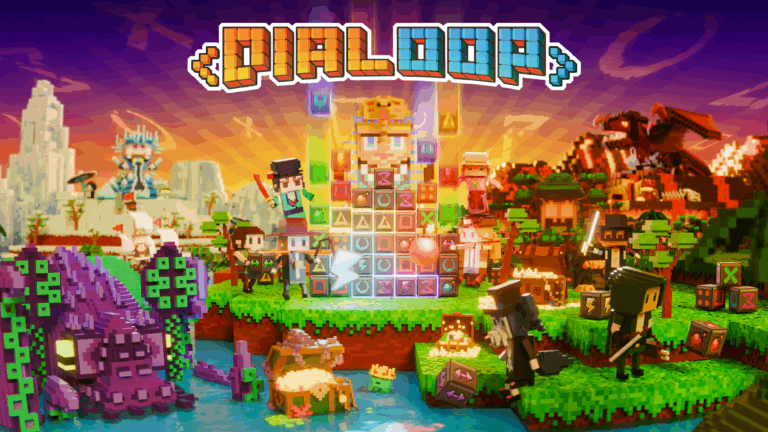
Dialoop is a puzzle roguelite-style game by Byking that is easy to understand from the very first moments and holds untapped potential in its core gameplay. However, its agonizing art style and nausea-inducing design choices actively gave me motion sickness and forced me to physically turn my head from what was happening on the screen. While the tile-sliding, combo-chaining gameplay can be satisfying, and the story has hints of solid humour, Dialoop falls short in the margins and fails to leave a lasting impact beyond a residual headache.
Core Gameplay – A Puzzle with Potential
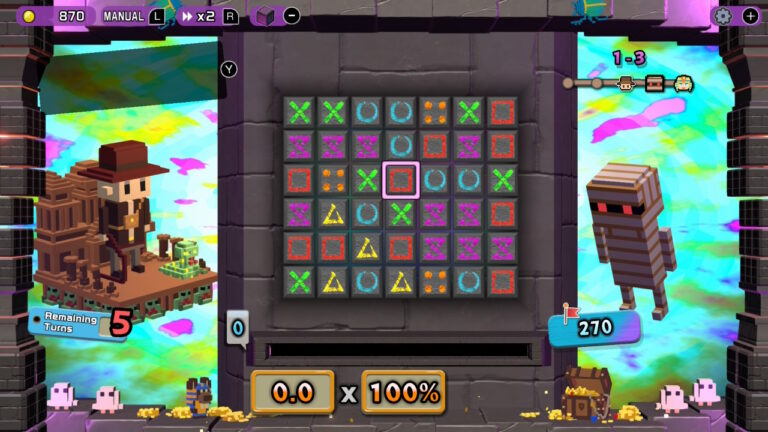
The core gameplay of Dialoop is a blend between Puzzle League-style colour-matching and classic slide puzzles. Clear out blocks and earn points by lining up at least three of a single colour in a row or column. Clear four or more, and your cleared blocks will convert into a single special block that will clear the board in different ways while netting a few extra points.
Seeing the grid of blocks, you take a turn by selecting one block and moving it around the board however you see fit, but for every move you make, the entire row is shifted with each press of the D-pad. Use this to your advantage, because manipulating the layout of the board could clear multiple sections, multiple colours, or even a line of a single colour that spans from one border to the other.
Level by level, you’re charged to push your points total beyond a certain value in four turns or fewer. Blocks are each designated a point value, and that value multiplies as you clear more blocks from the screen. Surpass the limit, and you’ll advance; fail, and you’ll suffer an unceremonious death.
Roguelite or Puzzle? Dialoop’s Identity Crisis
The key quality of any worthy roguelite title is the urge to push for “just one more run”. Death should feel disappointing, agonising, and frustrating to the point that you couldn’t possibly put the controller down until you can push just a little further. But the gameplay of Dialoop doesn’t evolve as you progress, so death never feels like a barricade blocking the path of something new. When I feel like I’ve seen it all after just a handful of runs, I feel no urge to delve back into another. In this sense, Dialoop fails as a roguelite, and feels more well-suited as a high-score puzzle game. There’s nothing wrong with that; it just seems Dialoop misdiagnosed itself.
Story – Lost in Translation
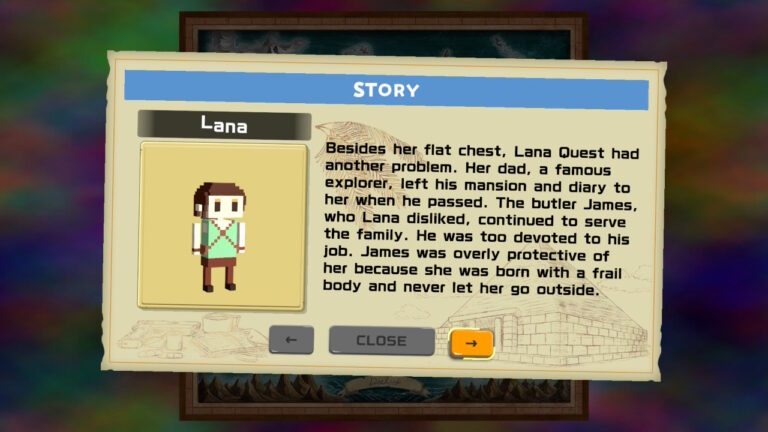
The story likewise has no impact on the gameplay, even when entering a run with a new character — which you’ll gradually unlock as you play. Every player has different motivations and different values when it comes to attacking the different worlds and their punctuating boss battles, but it’s all told entirely through waterfalls of text. The text-heavy story varies based on the character you select, which adds the bare minimum variation for the countless runs this game’s roguelite style pushes you to embark upon.
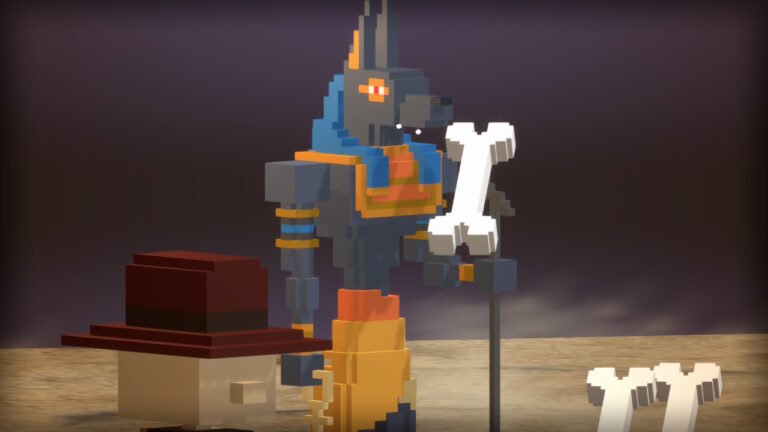
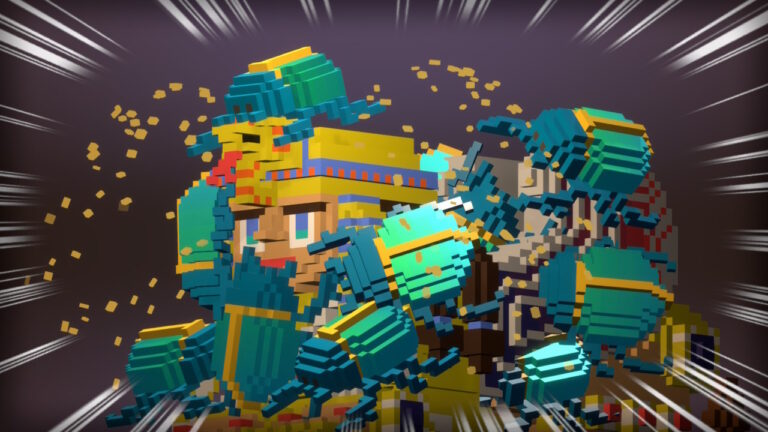
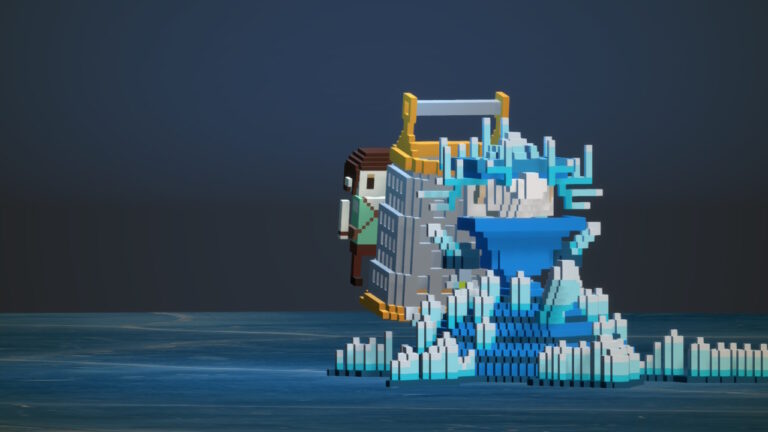
There’s some real imagination and creativity at the core of the post-boss death scenes, and a few funny ideas that simply fail to hit their mark with the stiff, lifeless animation and muted voiceover. The story is conveyed through two mediums: flavourless pages of poorly translated — or at best, poorly-written — exposition, and boss defeat cutscenes. Neither of which is very understandable or entertaining. I played Dialoop in English, and every page of text feels like it had been translated directly through Google.
When you’re reading, the yawn-stoking verbiage was paired with a nauseating back-and-forth tilting action in an effort to give the pages some semblance of life. It was headache-inducing, and made me fight to avoid skipping through the meaningless story beats.
Sound and Visuals – Overstimulation to the Extreme
The sound and visual effects are reminiscent of a slot machine on the cigarette-perfumed floors of your typical Las Vegas casino. Chaining massive combos can also feel about as intentional as a slot machine, where I often stumbled across screen-clearing, colour-chaining sequences by chance, rather than by my own strategic thought process. A little luck can go a long way to keep a run going — which is fine in a game of this style — but luck often felt like the driving force as blocks fell into the screen and chained another three or four tallies onto the combo by complete happenstance. This often made victories feel undeserved, or at best minimally satisfying, as I didn’t defeat a stage thanks to my powerful brain, but rather by shuffling the tiles until enough blocks were flashing — the game’s choir-toned indicator that you’ve notched a match.
There were times when I, by no ability, strategy, or intuition, could clear an entire level by simply pressing the “A” button. No sliding, no moving, and no adjusting; just a single button input and the horrible foe before me melted like papier-mâché.
⚠️ Motion Sickness Warning: The visuals are overstimulating in the worst ways. With a clunky, charmless, blocky art style set on a foreground of psychedelic liquid mercury, with colours constantly shifting, shaking, rippling, and moving around in the background, I had to look away from the screen regularly during my playthrough to simply give my eyes a break. It all physically hurt to watch, and that isn’t hyperbole.
Not even the intermittent pages of story were safe from perplexing design choices, with every page undulating left and right in a seasick sway. The options menu was just as irritating, with no words sitting still for even a moment. Horrible design choices plague Dialoop, and most of these decisions would have been avoided if they had just done what made sense, rather than what might pair best while listening to Pink Floyd’s Dark Side of the Moon.
Music – Highs and Lows
At times, the soundtrack of Dialoop can complement the boss battles quite well, with epic backing tracks to add a bit of oomph to the fights. The music hit its peak in the multiplayer mode, though, when a jukebox item transformed the game’s sound chip into a brand-new 8-bit melody. That was fantastic. The musical mixing completely drowns out the victory cutscenes, though, smothering the voice acting and awkwardly tilting the scene’s mood askew.
Multiplayer – The Strongest Mode
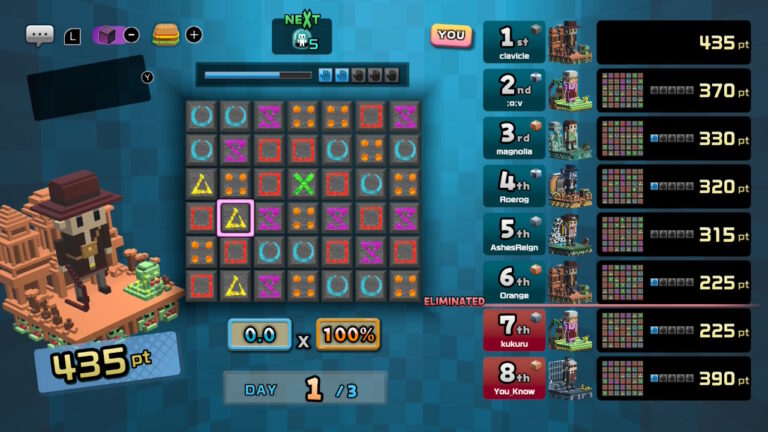
Multiplayer could have been this game’s saving grace had speed come into play beyond a simple first-come-first-served item grab between rounds, but when combos and score matter above all else, I’m incentivised to take it slow. My sloth method has notched me a top-two finish in every multiplayer bout at the time of writing this review. Speed could have added exciting new wrinkles to the formula by forcing the player to chain combos before their opponents jumped too far ahead to catch, but the battle royale elimination system still makes multiplayer the strongest mode of this release.
Even the numbers on the multiplayer podium won’t sit still like the character models above them, each wiggling and moving in a different way for no clear reason besides forcing me to dart to hold my face above a toilet bowl.
✅ What Works
- Clever puzzle mechanics with combo-chaining
- Multiplayer mode is the most engaging
- Some genuinely creative post-boss death scenes
- 8-bit jukebox tracks are fantastic
❌ What Doesn’t
- Nausea-inducing visual design
- Poorly translated, uninteresting story
- Fails as a roguelite – no meaningful progression
- Luck often trumps strategy
- Motion-sickening UI and text pages
Verdict
Dialoop doesn’t arrive with a premium price tag at just $7.99, but even with that caveat, this is a game that doesn’t deliver in overall value. It works at a baseline level — the puzzle mechanics make sense, the roguelite upgrades and systems function as intended, and the multiplayer unveils the best version of the game. Poor writing and painful design choices hold the title back. When true moments of creativity arrive, the charm is ripped away by an ugly art style and minimal animation that only serves to make the characters and bosses feel more like wooden blocks than what they’re attempting to portray.
Dialoop is not a lost cause, but with a core gameplay loop that’s no better than average and holds little variety, the subpar presentation and abhorrent visuals make this title a forgettable one. Though there can be moments of satisfaction when chaining together an extended combo, or pushing to the lead of an online elimination match, this is a game that would be better served if it ditched the roguelite schtick and leaned all-in on its puzzle gameplay — and completely overhauled its story delivery system with stronger writing and text that would sit still while you’re reading. Most of Dialoop‘s injuries are self-inflicted, but there’s just not enough meat at the centre to chew through the fat.