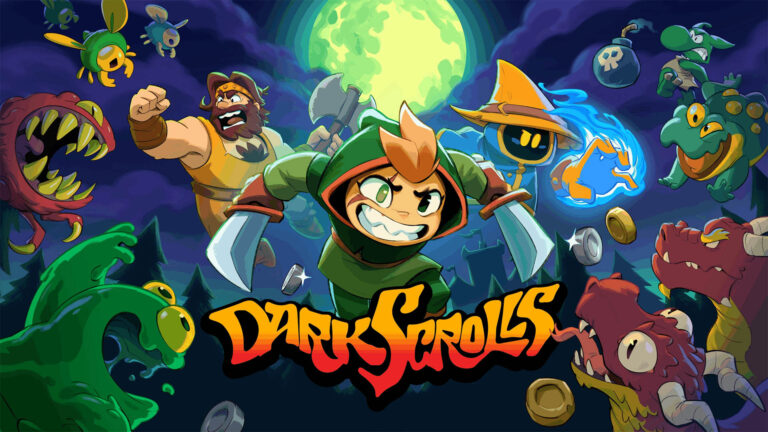
Dark Scrolls‘ developer, doinksoft, originally planned to drop this game on May 28, but strategically delayed its release by a month to avoid getting swallowed by indie giant Mina the Hollower, which would release one day afterward. A gothic-style retro-flavoured adventure like this was bound to get lost in the jumble if it shared a release window with one of the most highly anticipated games of the year. Which would have been a shame, because Dark Scrolls is one of the tightest retro shmups I’ve played in a very long time. It was well worth the wait.
Overview
-
Developer: doinksoft
-
Publisher: Devolver Digital
-
Platforms: PC, Switch (Reviewed)
-
Release Date: June 22, 2026
-
Price: $9.99
A Clever Name and a Classic Premise
I can still conjure memories of the horrible feeling of dread that consumed me whenever a 2D platformer slapped me with an autoscrolling level. From the moment that level booted up, the world was a treadmill. Those levels were the worst — either way too fast or way too slow to be entirely satisfying.
My stomach lurched when Dark Scrolls immediately pulled that autoscrolling rug out from beneath my feet. This latest retro-inspired release from the creators of Hellbrella and Gato Roboto is a dark yet bouncy shmup built around an autoscrolling mechanic. Hence the name: Dark Scrolls. Clever.
Of course, the game’s title isn’t entirely derived from changing a few letters in a FromSoftware hit. The titular Dark Scrolls are actually the impetus for this game’s story. Before seeing the opening title, you’ll be met with an exposition cinematic that tells of brave adventurers who challenged a three-headed dragon for the magical scrolls, only to be destroyed by an evil knight who snatched the heroes’ prize and used it to destroy them. Somehow emerging from the grave to right this wrong, the adventure begins as a fist punches out from beneath the earth.
Three Distinct Characters, Endless Replayability
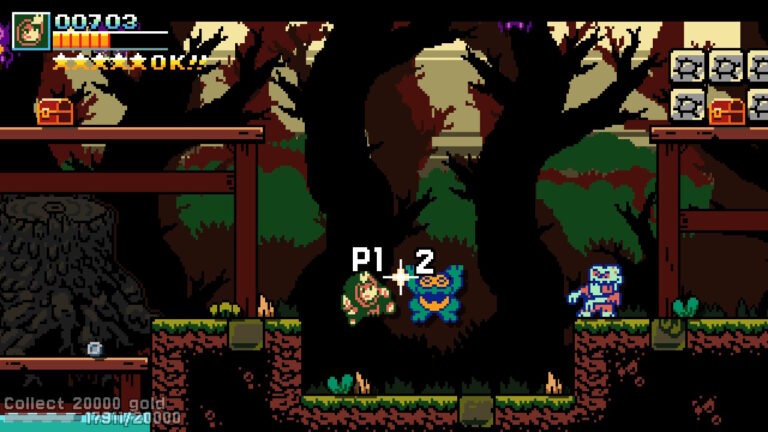
While it looks like a 16-bit action platformer from afar, the gameplay of Dark Scrolls plays much more like a shoot-em-up fused with roguelite mechanics. With an auto-shooting mechanic for clearing screen after screen populated with hordes of hostiles swooping in from every corner of the map, how you surf the waves of enemies is entirely up to you, as you’re given the choice of three playable characters from the beginning, each with their distinct playing style.
Grizz is the gruff axe-tosser with arched attacks that soar across the screen, and a special that clears the screen with an overwhelming barrage of battle-axes. Flashing a stern bush and an aerobics leotard, this chiseled softie is the most all-around character in the game, and a great starting point for finding your footing in the early game.
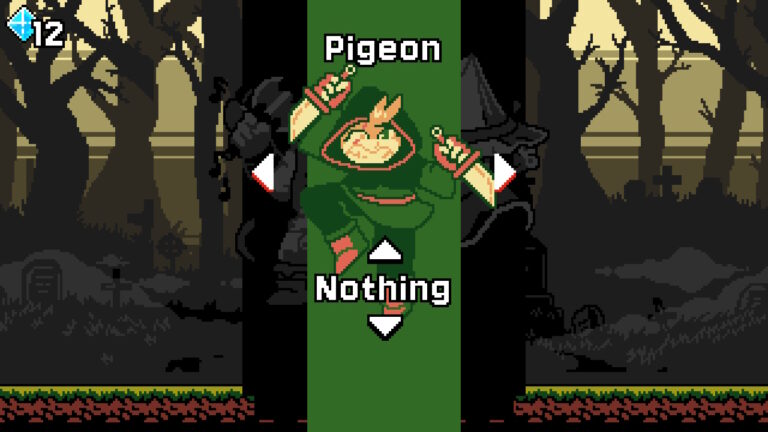
Pigeon is my personal favourite — the character I leaned on in my first victorious run. He’s quick while not attacking, uses speedy, short-range daggers as his primary attack, and has a powerful stealth special that makes the player invulnerable until unleashing an incredibly painful attack — classic thief archetype. I was able to clear some of the bosses in seconds.
Emerys… also exists. Certain playstyles will certainly click with his bouncing projectiles and zooming double-jump, but I couldn’t get a grip on his quirks.
But that’s okay! This is one of Dark Scrolls‘ greatest strengths: the character variety is balanced with their own wholly unique play styles. You’ll unlock plenty more characters as you continue to dive deeper into the game’s branching paths, often feeling helpless to recruit some of the downtrodden weirdos you come across until suddenly a new character’s strength makes the solution incredibly obvious.
This adds plenty of replayability to the quick gameplay loops, because it incentivises second, third, and fourth runthroughs and gives the player reason to clear the stages with every character. Each character is given side objectives to complete while darting for the Dark Scrolls — small things like using your character’s special attack, defeating enemies in a specific way, or even simply scraping up a certain amount of cash. Having a secondary objective can squash any monotony that comes from running the same routes over and over again.
Tight Controls and Classic Challenge
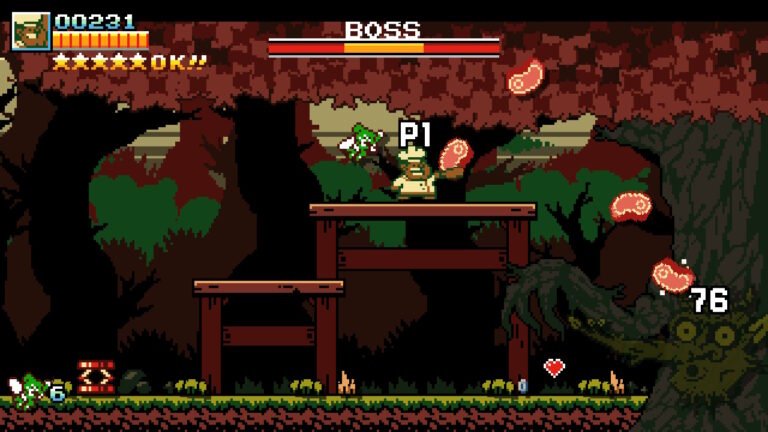
The controls are simple: jump and shoot. If you hold down the Y button on the Nintendo Switch, you’ll auto-fire your weapon, allowing you to move in any direction while maintaining the direction of your attacks. Take down enough baddies and your star meter will gradually fill up, giving you the option to unleash a special attack.
Depending on your character, you’ll even be able to double-jump while airborne. For some, this move is simply a means to climb a little higher; for others, it’s all about manoeuvrability; but some will utilise that double-jump as a form of offense, attacking those below with a ground-pound or by slinging daggers. All characters have their own variations of these moves, each with their own distinct style and strategy.
It’s vintage side-scroller action with a classically simple control scheme, and this is where Dark Scrolls shines the most. Cutting out the fat and distraction of high-end graphics, this game is rich with the same old-school challenge that stretched runtimes of retro sidescrolling all-stars like Mega Man, Castlevania, or Contra. Tough, but fair — that’s the recipe.
And though the roguelite elements will provide you with stronger and more strategic power-ups throughout the game, the primary obstacle standing between you and the final boss is your ability to understand the game, learn from your mistakes, and simply get good.
The Flaws – Minor but Noticeable
On the topic of power-ups, I’ve found it practically impossible to lose by simply equipping several health fairies and attacking bosses head-on with little regard for my health bar. Get three or so, and you’re practically invincible. Still, if you want more of a challenge, it remains your right to upgrade your run as you see fit, so this exploit is more of a take-it-or-leave-it gripe, though one late-game boss in particular feels especially impossible without a constant stream of health pickups.
What isn’t a trivial issue is the fact that the Switch 2 Pro Controller doesn’t work with this game. From the moment it boots up, the Pro Controller turns off and will not turn back on. While the precision of the Joy-Con’s four-button D-Pad works perfectly fine within Dark Scrolls‘ needs, I’m frustrated to have my options limited. Hopefully, this issue is remedied in a future patch.
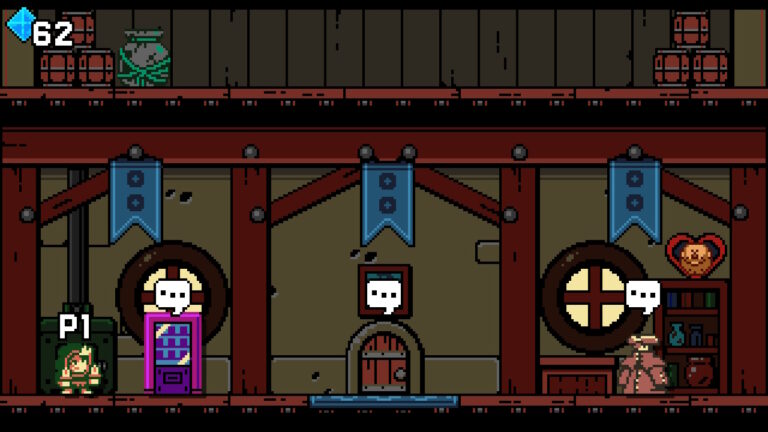
And while they’re at it, some of the enemy placement could use a bit more fine-tuning. I don’t mean in the meat of the levels — in fact, most enemies are placed expertly in areas that require the player’s expertise to vaporise. But after entering rooms where the game’s trademark sidescrolling halts — challenge rooms and shops, primarily — it’s up to you to restart the momentum by running to the far right side of the screen. This system works well, but it’s not uncommon to be damaged by an enemy just out of sight. I rolled my eyes every time I was hurt by a foe that I couldn’t see, and this should have been cleaned up prior to release.
A final word of caution: do not skip forward in any character interactions, or you’ll get an eardrum-rupturing bit-crushed pop almost as if all the skipped dialogue beeps and boops were smashed together. These issues are far from game-breaking, but the overall package would be practically flawless if it weren’t for these annoyances.
Visuals and Audio – Pure Retro Magic
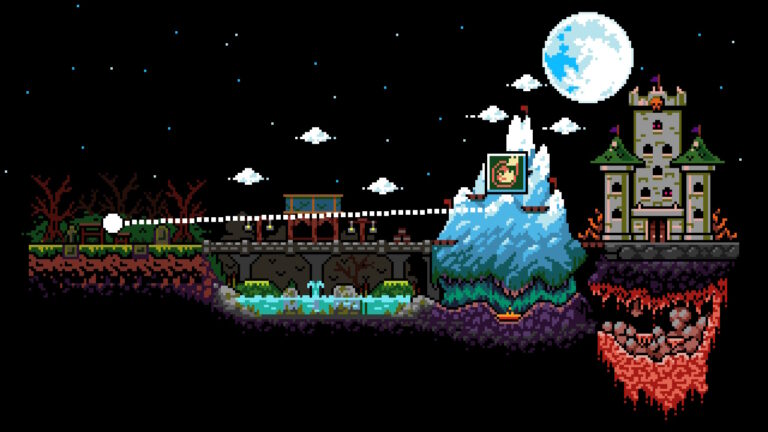
The art style stands out from the very beginning, as everything in this game feels ripped straight out of the 16-bit era, from the stages and weapons to the sprites and some impressive non-gameplay pixel art. The visuals feel right at home in this style of game, though the stretch-and-squish animation, Mario Maker backdrop shadows, and buttery frame rate are sure to remind you that you’re playing a modern release. Some sprites are more well-done than others, and the colour choice of some sprites probably would’ve been better off framed in black than the colours the artists opted for, but the aesthetic is cohesive and clean overall.
The entire package is wrapped by a head-bopping soundtrack with a distinctly Sega Genesis electric twang. I was tapping my toes and swaying back and forth in my chair from the very first level. It’s gritty and rocking in all the best ways, and adds both atmosphere and an energetic, arcadey feeling to every run.
Verdict
You’ll naturally improve with every run in Dark Scrolls, and learning the mechanics of the game gives way to a deeply satisfying sense of progression. This game knows precisely what it wants to be, and its identity is apparent in every frame. The gameplay is tight, and the desire to play through one more round is magnetic even after defeating the final boss at the end of the route. It pushes you to experiment with new characters, new strategies, and new play styles.
Dark Scrolls is retro for all the right reasons, and very few of the wrong ones. You’ll get plenty of substance considering its budget price point. It takes everything you love from retro shmups and cleans it up with all the bells and whistles of a modern-day roguelite. Pick it up — but know you’ll never want to put it back down.