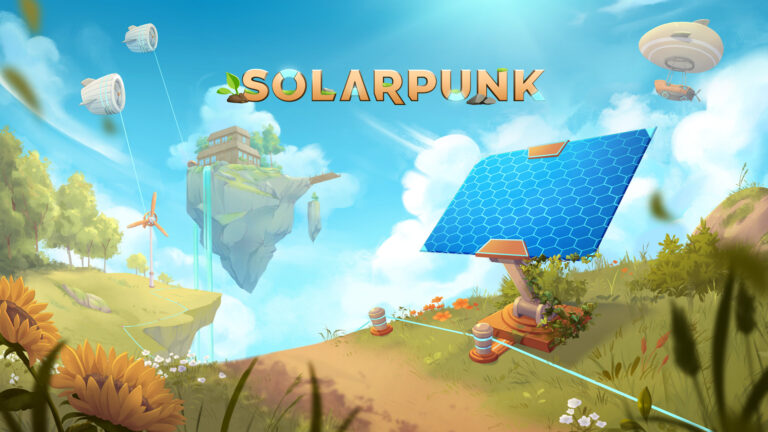
Solarpunk is an open-armed embrace, welcoming you to a world at your disposal. As a typical sandbox-survival affair, this June 2026 release plants you into a world and calmly invites you to make it your own. Its world is one of safety, security, and comfortable possibility where your unrefined toolkit evolves in tandem with your understanding of the systems. There is ample space for experimentation and a wide-spanning sky to explore — but there’s no need to rush.
Solarpunk will leave the porch light on for you, provided that porch light is powered by solar energy.
A Gentle Onboarding Process
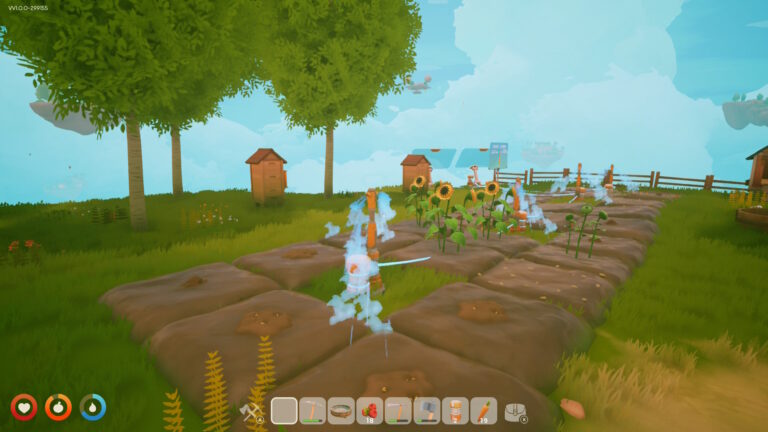
Solarpunk checks every box you’d expect from a title of its ilk from the very first moments of gameplay. Spawning with some simple tools already in your inventory, you’ll chop down trees, mine stone and ore, and plop a crafting table on the ground to start creating. The tutorial segment is entirely optional — toggle it off in the settings menu — but it takes no more attention than a part-by-part checklist in the upper-right corner of the screen.
That list is well laid out for new players who want to know where to start before they can be truly let loose, galavanting through their own private sky island. Item by item, you’ll learn to craft, to build, and to leave your mark on the world around you. The learning period is very straightforward, and you’ll shed your training wheels in minutes.
When night falls, you won’t be overrun by minions of the underworld; you’re not in danger of so much as a bee sting from your swarming beeswax farms. In fact, absolutely nothing can harm you in this whole wide world, besides starvation, dehydration, and falling from a great height.
Should you miss a step and find yourself tearing through the atmosphere as you watch your home shrink into obscurity above you, you’re at no risk of losing the items in your inventory so long as you can return to the spot where you met an untimely — and completely reversible — demise.
Building Your Sky Sanctuary
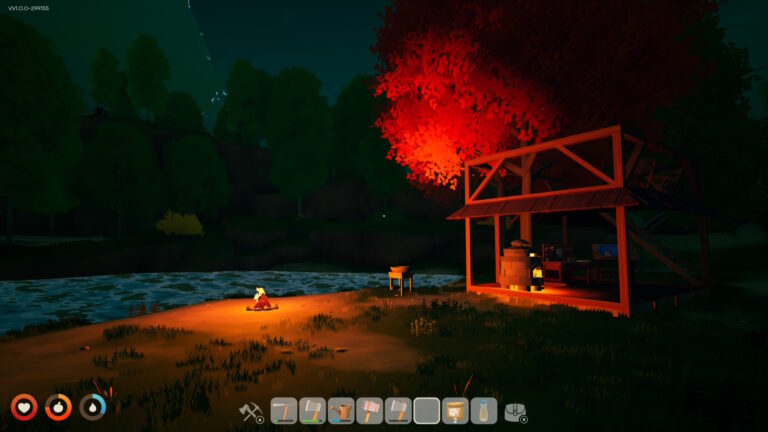
Between your obligatory crafting table and its companion, the research table, you’ll be able to utilise the island’s resources to create new things to mess around with. The building hammer allows you to place foundations, stairs, doors, walls, windows, and roofs — all from the ease of an easy-to-understand (though occasionally temperamental) radial wheel of options. It’s not perfect, but you can build nearly anything you can imagine, so long as you have enough resources to supply your project.
But after a while, spending day after day on the same sky island can become a bit stale. Staring out into the infinite skyline, you’ll certainly notice several floating islands much like yours. When you’re stocked up enough to craft an airship, those islands are yours to scour… eventually.
It wasn’t until I first constructed an airship and saw myself in a cutscene shot from a third-person view that I even considered the fact that the main character was a woman. Maybe I’m a bad person. The title does have a character creation tool available from the main menu, but it’s frankly so minimal when it comes to options, and you’ll almost never see more of your player character than the hand gripping your piffy pickaxe.
Exploring the Sky — A Mixed Experience
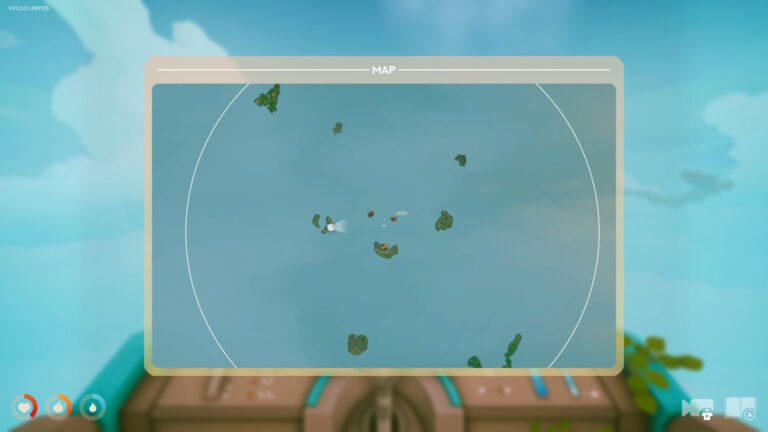
Back on the topic of air travel, the islands are a much better inclusion in theory than they actually proved to be in execution. As you upgrade your airship, you’ll increase your travel radius and gain access to farther and farther islands. For how few islands dot the sky — only about a dozen in total — I expected more to do and discover. But these landmarks provided little more than a new type of ore, a new animal, or a new crop.
On the surface, these are all worthy reasons to explore the world around you, but these new resources are the only reason to come back to an island once you’ve stolen the handful of plants on its surface. I would have hoped for a reason to build a fun new base, find a new challenge, or discover some new-fangled technology to play around with — but more often than not, I never stayed much longer than a few minutes in any new location.
I felt no desire to build a second base or solar farm on another island, as I had all the space I needed on the island I first spawned on. I didn’t even bother wasting my resources on building more than one other dock, as it was practically as simple to float above the surface and automatically dock from there.
The Stakes Are Non-Existent
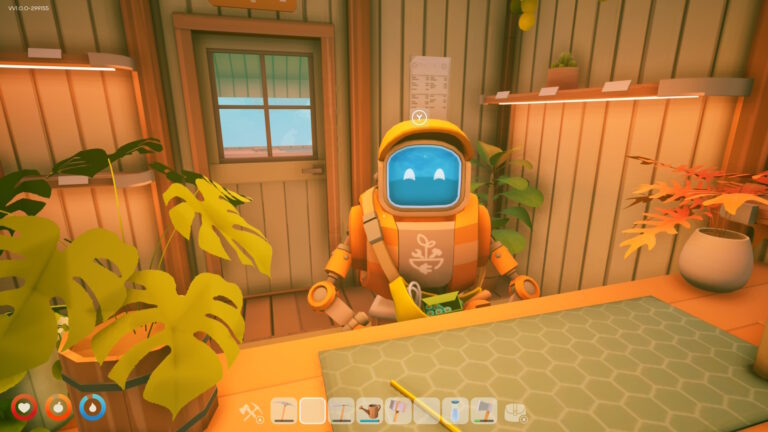
The stakes are non-existent, nor is there any overarching story or quest to spur your progression. Your adventure is measured in trades made with the robotic merchant floating nearby your first island, who will give you blueprints to craft more technologically advanced tools to simplify the menial tasks that got you to this point. This merchant is also your source for airship upgrades, so you’ll make many return trips to his airborne shop.
New technology like drones and drills help you automate the process, but these innovations can feel like solutions to problems that the game created itself; flying to the same island to hack at a patch of rock is little more than an obstacle between you and your creative expression. It’s a sandbox with a bouncer.
Despite discovering new crops to plant, they all grew via identical methods. Despite discovering new ore to mine, they were all utilised in identical ways. Variety is only as deep as its cosmetics in the world of Solarpunk, which is a shame. If the goal is truly to explore and experiment with the elements of the world around me, it’s a shame that gathering enough resources to trade with the merchant to upgrade my ship feels like scratching items off the list before I’m allowed to fully explore. The back and forth between islands feels like mindless fluff at times, especially when the wonder of air travel wears off.
Company and Companions
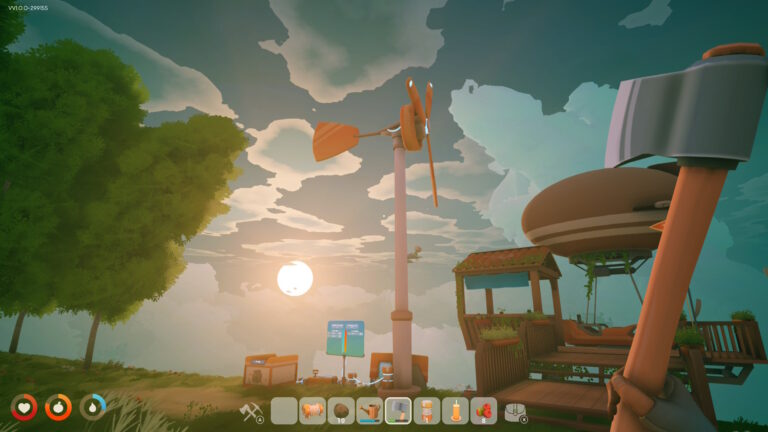
By all means, spend hours upon hours focused on constructing your dream house, maximising your cropland, or whatever strikes your fancy at the moment. With nothing to threaten your safety and all the time in the world to enjoy your surroundings at your own pace, Solarpunk‘s tone is much more akin to Animal Crossing despite playing more like Minecraft.
Unlike Animal Crossing, however, you’re all alone in this world if you don’t have any friends to bring along for the journey. And if you do have friends willing to tag along, you’d better not bank on the Switch 2 version, which doesn’t yet carry functional multiplayer. Maybe this is a good thing, considering the bare-bones character creation tool would make it hard to distinguish between your friends at a glance.
This is where the animal life resurrected my crippling loneliness. That’s right — life exists on other islands, and discovering living creatures and bringing them to my home base added more to my list of responsibilities (my watermelon empire isn’t going to establish itself) but also offered me some company to help me brave the harsh storms.
Storms and Performance
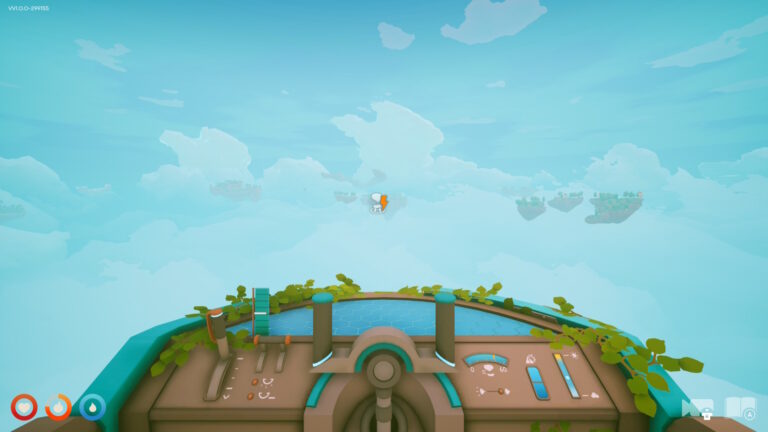
Speaking of the storms, you’ll find your island struck by strong winds, rain, and even lightning at times. In storms, you’ll lose all visibility in the air, though the map remains fully functional if you need to orient yourself. Lightning strikes will destroy your crops, and the rain will destroy your frame rate.
Performance issues are abound in the Switch 2 version of Solarpunk. Though the game aspires to run at 60 frames per second, it’s rarely consistent enough to maintain that peak — especially as you construct more and more machines throughout the world. It’s nothing game-breaking, but it’s noticeable at every stage of the game.
I came across several glitches along the way, too, including one that made the terrain flash in and out when I disembarked from the airship, and another where machines like the lever and the rain and daylight detectors (different from solar panels; those work wonderfully) were completely ineffective in my playthrough. Time continues to pass if the game is running in the background, and occasionally while in sleep mode, making the in-game clock on my world read over 80 hours — nearly four times my actual play time.
The game handled about as you’d expect both while using a Switch 2 Pro Controller and in handheld mode, though the lack of mouse controls is a strange decision considering Solarpunk also released on PC at the same time as on consoles.
Visual Splendor
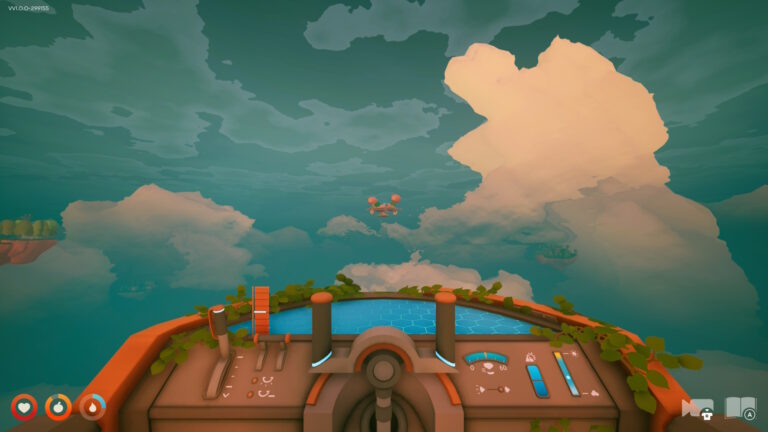
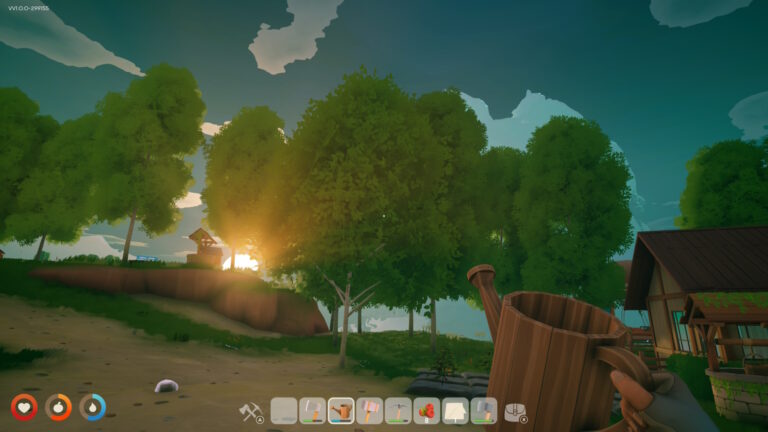
At its best, Solarpunk‘s art style and lighting systems make for countless stunning views. The piercing beams of a sunrise are just as brilliant as the glowing embers of a campfire, and the sky is beautiful enough in its own right to make air travel both soothing and engaging. It feels like floating through a watercolour masterpiece. At its very best, I couldn’t keep my thumb away from the screenshot button.
The music in Solarpunk doesn’t stand out, and I mean that in a positive way. A title that prides itself on offering an entirely safe space to express yourself, experiment with new technology and mechanics, and explore the sprawling world around you is one best complemented — not headlined — by a strong soundtrack. The musical score is exactly what you’d want in a no-stress experience like Solarpunk. But if you’re not a fan of the music, no problem, because you’re free to decrease or increase the music’s frequency in the options menu.
✅ What Works
- Stunning art style and lighting
- Peaceful, stress-free atmosphere
- Flexible building system
- Excellent sense of exploration
- Accessible for all skill levels
❌ What Doesn’t
- Limited island variety and depth
- No stakes or overarching story
- Switch 2 performance issues
- No multiplayer on Switch 2
- Bare-bones character creator
Verdict
Solarpunk is a game that primarily caters to the needs of a specific audience, while dissuading others from booking an extended stay. The canvas it provides for creativity is high, as its offerings are incredibly versatile, and players are set loose in a world that breeds innovation. If you love painstakingly planning and constructing the ultimate team base, maximising the energy output of your technology to make beautifully automated machines, or simply basking in the atmosphere of a quiet, peaceful world, you’ll feel right at home with Solarpunk and its rewarding gameplay loop.
But if you’re looking for depth, challenge, or a reason to explore beyond the first island, you may find the sky isn’t quite as full as it first appeared.